Scabies
Overview
Scabies is a parasitic skin infestation caused by the mite Sarcoptes scabiei var. hominis. The condition results from an immune reaction [delayed hypersensitivity (Type IV) to mite antigens] to the mites, their saliva, eggs, and feces. Globally, scabies affects over 200 million people at any given time, with approximately 455 million new cases annually. It is particularly prevalent in tropical regions with overcrowded living conditions and limited access to healthcare.
Epidemiology Trends
Recent studies highlight significant trends:
- Global prevalence remains high at approximately 2.71%, with spatial clustering in tropical Latin America, Southeast Asia, and Pacific Islands
- Rising incidence rates in high-income regions like Australasia and parts of Europe.
- Institutional outbreaks are common in hospitals, nursing homes, schools, prisons, and refugee camps due to overcrowding.
- Seasonal peaks occur during cooler months (February–April).
The Royal College of General Practitioners (RCGP) reported that, as of late 2024, scabies cases in England had risen to approximately three per 100,000 people, doubling the five-year seasonal average. The northern regions of England have been particularly affected, with rates reaching six per 100,000. This surge has been attributed to factors such as increased social interactions post-pandemic and challenges in accessing timely medical care.
Animal Scabies
Animal scabies (Sarcoptic mange) caused by different species of mites affects cats/dogs but does not transmit between humans and animals in the UK. Infestations are confined to contact areas and require veterinary treatment.
Transmission
Scabies is primarily transmitted through prolonged or frequent skin-to-skin contact. While less common, transmission can occur via fomites, such as contaminated clothing, towels, or bedding. Mites can survive on these objects for up to 3–4 days.
- Casual contact (e.g., handshakes) is unlikely to spread scabies.
- Crusted scabies poses a higher risk due to the large number of mites present on the skin.
Incubation Period
- First infection: Symptoms appear within 2–6 weeks.
- Reinfection: Symptoms develop faster, typically within 1–4 days.
Clinical Features
Classic Scabies
- Symptoms:
- Intense itching (worse at night).
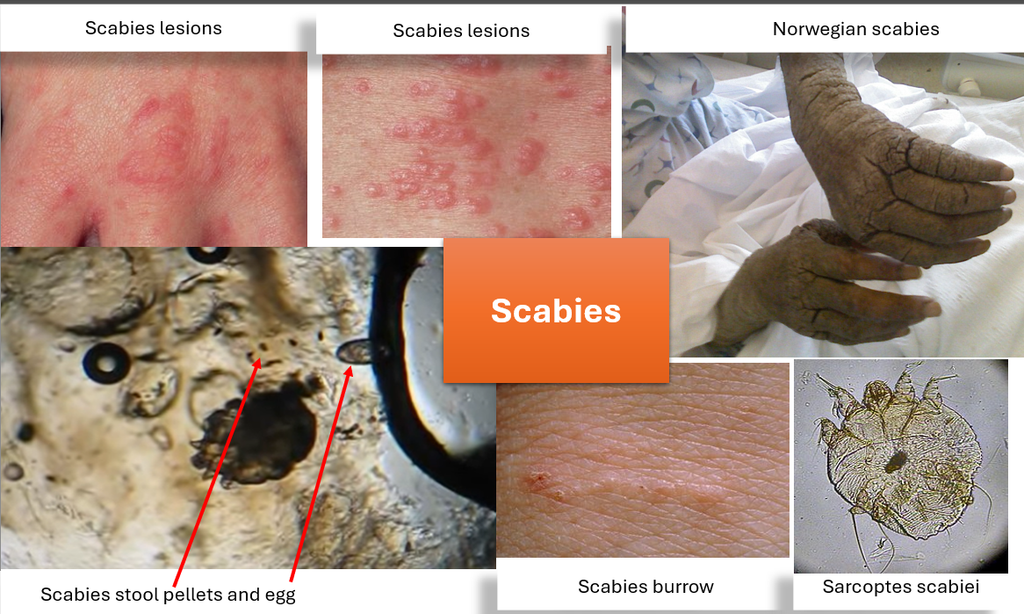
- Slightly raised thread-like burrows along intradermal tunnels made by mites. A black dot may be visible at the leading edge of the burrow.
- Commonly affects web spaces of fingers, axillae, nails, and flexor aspects of wrists.
- Rarely involves the face or scalp in adults but may affect children under five from head to toe with eczematous lesions.
- Nodular lesions on buttocks, scrotum, penis, and groin are highly specific for scabies.
Norwegian (Crusted) Scabies
- Seen in immunosuppressed individuals, elderly patients, and those who are malnourished or debilitated.
- Presents as thickened crusts and heavy scaling containing numerous mites.
- Itching may be absent.
- Harder to treat and disproportionately contributes to transmission.
HIV Patients
- May present with classic scabies but itching disappears when CD4 counts drop significantly.
Scabies Incognito
- Atypical presentation due to masking by topical or systemic corticosteroids.
- May mimic generalised eczema with widespread papular lesions.
Diagnosis
Scabies is primarily diagnosed clinically based on symptoms such as nocturnal itching and visible burrows. Additional diagnostic methods include:
- Skin scraping microscopy: Identifies mites, eggs, or feces (gold standard).
- Ink burrow test: Black/blue ink applied to burrows reveals zigzag paths after wiping.
- Dermoscopy: Visualizes mites and burrows.
- PCR/ELISA testing: Detects mite DNA or antigens (used in research settings).
Treatment
First-Line Treatment
- Topical Permethrin 5% Cream:
- Apply over the entire body (including scalp for children <2 years), leave for 8–12 hours, then wash off.
- Reapply after 7 days to ensure complete eradication.
- Malathion 0.5% Liquid:
- Alternative for patients allergic to permethrin.
Crusted Scabies
Combination therapy is required:
- Topical permethrin daily for one week, then twice weekly thereafter.
- Oral ivermectin (200 µg/kg) on days 1, 2, 8, 9, and 15 (additional doses on days 22 and 29 if needed).
Symptom Management
Persistent itching post-treatment can last up to 4 weeks:
- Use crotamiton 10% cream (2–3 times/day) for symptomatic relief.
Infection Control
Scabies is not a notifiable disease but requires strict measures in healthcare settings:
- Isolate affected individuals until 24 hours after treatment initiation.
- Use PPE during close contact until treatment is completed.
- Trace contacts up to 8 weeks prior:
- Household members, intimate partners, hospital staff without PPE, hairdressers/podiatrists.
- Treat all contacts simultaneously with two courses of topical treatment spaced one week apart.
Laundry Protocols
- Wash contaminated items at 50–60°C, per UKHSA guidelines.
- Items that cannot be washed should be quarantined for four days or treated via dry cleaning/tumble drying.
Environmental Cleaning
- Deep clean rooms; fumigation is not required.
Prevention Strategies
Preventive measures include:
- Avoid direct skin-to-skin contact with infested individuals.
- Treat all household members simultaneously if one person is diagnosed with scabies.
- Wash bedding/clothing in hot water (>50°C) and dry at high heat settings.
- Seal non-washable items in plastic bags for one week.
- Clean/vacuum rooms thoroughly after treatment37.
Mass drug administration (MDA) strategies using ivermectin have shown promise in regions with >10% prevalence
Outbreak Definition
An outbreak is defined as two or more epidemiologically linked cases within eight weeks.