Cryptosporidium and Cyclospora
Quick revision
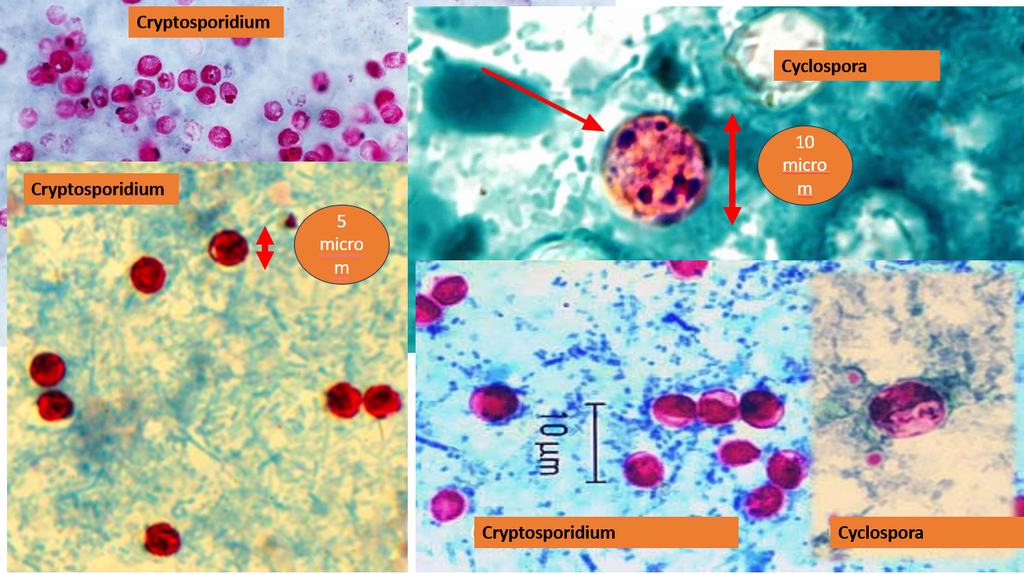
| Cryptosporidium | > Worldwide distribution; Fourth most common cause of gastrointestinal infection in the UK. > 2 of 30 species affect humans: C hominis and C purvum. C purvum is mostly animal-associated. > Transmission: Water-related: contaminated drinking water, swimming pool (not affected by chlorination), water park; contaminated food (apple cider, unpasteurised milk; animal contact (C parvum); sexual (GBMSM), respiratory route (rare) > infective form is the oocyst. > The incubation period is 7-10 days. > In immunocompetent people, self-limiting disease; in immunocompromised – persistent diarrhoea. > Investigation – modified Ziehl-Neelsen (MZN) acid-fast stain (Cryptosporidium 5 micrometer, Cyclospora 10 micrometer), antigen test, PCR. > Treatment- In persistent cases, nitazoxanide or paromomycin +/- azithromycin > IPC – 48 hr exclusion; Oocyst may resist chlorination |
| Cyclospota | > Only one spp – C cayetanensis > Most cases are travel related, especially in Mesoamerica, e.g. Mexico > Transmission – Contaminated water, food (imported fresh food, raspberries, snow peas, lettuce, basil, cilantro (leaf coriander) and field greens) > Infective form Oocyst; incubation period – 7 days > Clinical feature – flu-like illness > diarrhoea(severe in immunocompromised) > Diagnosis: Modified acid-fast stain (variable uptake/ghost cells). Autofluorescence under UV microscopy (Cyclospora autofluoresces blue/green). Safranin stain > Differentiation from Cryptosporidium: Size: Cyclospora oocysts are larger (~10µm) compared to Cryptosporidium (~5µm). > Treatment – Cotrimoxazole (7 – 14 days) > IPC – like infective diarrhoea, isolate until 48 hrs symptoms free. |
I have combined these two as they often get asked together:
Cryptosporidium
Introduction
Cryptosporidium occurs worldwide and is the fourth most common cause of gastrointestinal infection in the UK. It is especially common in resource-poor countries with poor water hygiene, crowding, etc. It is most commonly seen in children aged between 1 and 5. Severe infection is seen in immunocompromised people (HIV, transplant, IgA deficiency, immunosuppressive drugs, hypergammaglobulinaemia, etc.). People with a deficiency in cell-mediated immunity are at risk.
There are more than 30 species, but only two infect humans: C hominis and C purvum. C purvum is mostly animal-associated.
Lifecycle:
The infective form is the oocyst. The oocyst forms sporozoites in the small intestine. Sporozoites then form merozoites by asexual maturation. These merozoites can cause infection in the same host (autoinfection). However, they can also mature sexually to become oocysts, which are fecally excreted into the environment and infect other hosts.
Transmission
- Water-related: contaminated drinking water, swimming pool, water park, etc. Cryptosporidium is not affected by chlorination.
- Foodborne transmission – contaminated food (apple cider, unpasteurised milk, etc)
- animal contact – farm exposure (mainly C purvum infection).
- Person-to-person contact – close contact, e.g. household
- Sexual transmission – in men having sex with men (MSM) population.
There is some evidence that airborne transmission may also occur. Respiratory cryptosporidiosis (rare) – causing symptoms like cough, shortness of breath, and wheezing, particularly in immunocompromised individuals (like those with HIV/AIDS) or young children often alongside diarrhea (https://pmc.ncbi.nlm.nih.gov/articles/PMC4135895/)
Clinical feature
The incubation period is 7-10 days. The patient presents with watery diarrhoea associated with abdominal pain, cramps, and a low-grade fever. Vomiting may or may not be present.
In immunocompetent people, it usually causes a self-limiting disease, but recurrence is known to occur. However, some patients may develop medium/long-term sequelae – arthralgia, eye pain, and diarrhoea.
In immunocompromised people, persistent and extraintestinal infection (mainly hepatobiliary disease – cholecystitis, pancreatitis, etc.).
Laboratory
Antigen test – Cryptosporidium oocyst antigen test (enzyme immunoassay )
Microscopy – modified Ziehl-Neelsen (MZN) acid-fast stain, HE stain, Giemsa stain, immunofluorescence, etc
PCR
Typing – MLVA typing.
Treatment
- In immunocompetent patients – Supportive treatment.
- In immunocompromised patients – Reconstitution of immunity (antiretroviral drug or reduction of immunosuppression).
- In persistent/severe symptoms, especially in immunocompromised patients –
- Nitazoxanide or paromomycin or Azithromycin
In severe cases, Nitazoxanide or paromomycin can be combined with azithromycin- It is given for two weeks or more, depending on the response.
| Nitazoxanide(healthy immune system) | Adult 500 mg BID x 3 days1–3 years: 100 mg BID x 3 days4–11 years: 200 mg BID x 3 days | Clinical cure (resolution of diarrhea) rates range from 72–88%. | |
Reference
https://www.cdc.gov/cryptosporidium/hcp/clinical-care/index.html
For HIV see this – Guidelines for the Prevention and Treatment of Opportunistic Infections in Adults and Adolescents With HIV (from clinicalinfo.hiv.gov)
Infection control
Precaution – Contact precautions.
Exclusion – 48 hours after first normal stool. Cases should also avoid using swimming pools for two weeks after the first normal stool. Oocysts resist standard chlorination.
Anyone whose T cell function is compromised should be advised to boil and cool their drinking water and water to make ice.
Cyclospora
- There are multiple species but humans are the only natural hosts of C. cayetanensis. It is an obligate intracellular parasite.
- Latin America (especially Guatemala, Honduras, Haiti, Peru, Mexico, and Brazil), Egypt, sub-Saharan Africa, the Indian subcontinent, and Southeast Asia.
- Transmission – Contaminated water, food or soil, poor sanitation, and low socioeconomic status. International travel.
Food implicated – imported fresh food, raspberries, snow peas, lettuce, basil, cilantro (leaf coriander) and field greens. - Infected form – Oocyst
- Incubation period – 7 days
- Clinical feature – initially flu-like illness for a few days, followed by rapid onset of gastrointestinal symptoms. Typical symptoms include watery diarrhoea, fatigue and muscle pain, loss of appetite, weight loss, cramping, abdominal wind or bloating, and nausea.
- Severe symptoms – in children, older people and immunocompromised (HIV).
- Diagnosis – microscopy (AFB stain – pink/red Oocyst approx 10 micromtr in diameter), PCR
- Treatment – Usually self-limiting. Cotrimoxazole (7 – 10 days; 14 days in immunocompromised), alternatives – nitazoxanide, ciprofloxacin.
- IPC – like infective diarrhoea, isolate until 48 hrs symptoms free.